


How to Scale a Small Business Without Running Out of Cash
Growth spends cash before it brings cash in. So if you want to scale a small business, the plan for money has to come before the plan for more sales, more staff or more locations.
- Growth costs money up front, while the revenue arrives later.
- Know your gross margin and cash cycle before you add volume.
- Line up funding before you need it, because lenders prefer a business that isn’t desperate.
Why growth can break a profitable business
Many owners are surprised when a record month leaves the bank account lower. Yet it happens for a simple reason. You pay for inventory, staff and ads now, while customers pay later.
Therefore, the faster you grow, the bigger that gap becomes. A business can be profitable on paper and still run out of cash. That is why you should not try to scale a small business on revenue alone.
Know your numbers before you scale a small business
Start with four numbers. Together, they tell you how much growth your cash can carry.
- Gross margin: what is left from each sale after the direct cost of delivering it.
- Cash conversion cycle: days to sell inventory, plus days to collect, minus days you take to pay suppliers.
- Monthly fixed costs: rent, software, salaries and loan payments, whether you sell or not.
- Owner pay: what you actually need to take out each month.
For example, with a 60-day cycle, the cash you spend to win this month’s extra sales comes back about two months later. As a result, a thin margin plus a long cycle is the most common reason growth stalls.
Build systems before you add people
Next, write down how the work gets done. A short checklist for sales, delivery and billing lets someone else do the job the same way you do. Then hire for the bottleneck that limits revenue, not for the task you dislike most.
Also, automate the repeat work first: invoicing, follow-ups, scheduling and reporting. Each hour you free up is an hour you can put into selling or managing.
The funding stack that helps you scale a small business
Different money fits different jobs. So match the source to the use, and use the cheapest capital first.
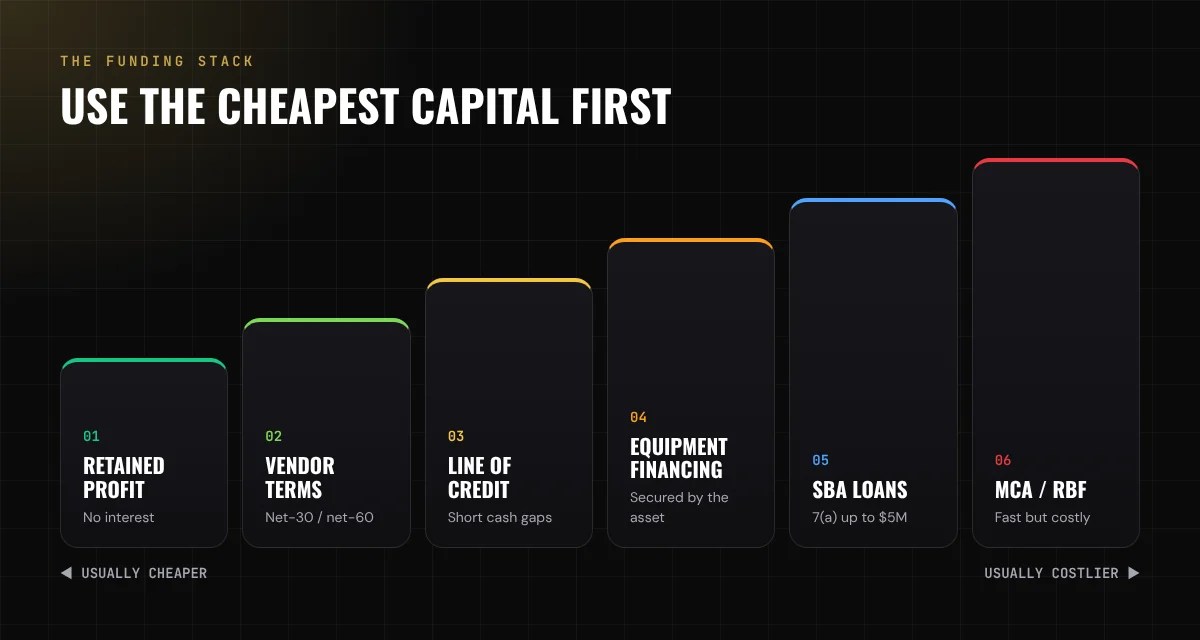
- Retained profit: the cheapest money you have, because it costs no interest.
- Vendor terms: net-30 or net-60 terms shorten your cash cycle for free.
- Business lines of credit: flexible money for short gaps in cash flow.
- Equipment financing: the equipment itself secures the loan.
- SBA loans: 7(a) loans go up to $5 million, while SBA microloans go up to $50,000.
- Revenue-based or merchant cash advances: fast, but often expensive, so read the true cost first.
Before most term loans, lenders look at whether cash flow covers the payments. Many use a debt service coverage ratio, and a common benchmark is around 1.25 or higher, although each lender sets its own rules. Meanwhile, a strong business credit profile helps with limits and terms.
Ready to scale a small business without guessing at the money? Business Funding Advisory maps the right capital to each stage of growth.
A simple 90-day plan to scale a small business
- Days 1–30: clean up the books, calculate the four numbers and set a cash floor you never go below.
- Days 31–60: document the core processes, fix the biggest bottleneck and apply for a line of credit while revenue is steady.
- Days 61–90: increase the one channel that already brings profitable customers, and review cash weekly.
This plan is deliberately boring. However, boring is what keeps a growing company solvent.
When to slow down
Pause new spending if cash drops below your floor, if customers start paying later or if margin shrinks as volume rises. Each one means growth is costing more than it returns. Then fix the cause before you push again.
In short, to scale a small business safely, plan the cash first, then the people, then the capital. That order is what lets growth stick.
Scale with a plan, not a guess
Kevinomics consulting covers the whole path: launching, building, business credit, scaling and strategy. Choose the stage you’re in, or apply and we’ll map the next move with you.
Further reading: SBA: loans for small businesses. Educational purposes only. This is not legal, tax or financial advice, and reading it creates no professional relationship. Trading involves substantial risk of loss. Individual results vary.


